Resource mapping identifies the resources that can realistically be mobilized for campaigning. Relevant resources include human resources (committed activists, skills, experience, and time available), financial resources, material and institutional assets, and networks (contacts, potential allies). Mapping resources helps you decide on the nature and scope of your campaign. It also assists in deciding which alliance members or participating organizations and individuals need to be brought in for their expertise, e.g. on VAW-related research, gender-sensitive communications or design, campaign experience, monitoring and evaluation. Even with limited resources, a small group can obtain good results if it strategically uses the strengths of its resources.
Simple lists or diagrams can be used to map resources:
- Human resources: What are the campaign needs in terms of human resources? How many persons can work on the planned campaign, for how many days a week, for how long? Map the knowledge and skills of the staff and volunteers available for the campaign: What is their experience and expertise? What have they been good at? What can they contribute to the campaign?
- Financial resources: What financial resources are needed and how can these be mobilized? Are any funds readily available? Where can one apply for funding? How long will it take? A proper fundraising strategy and sound financial management are key ingredients to a successful campaign. For more detailed information, see Finances and Fundraising Strategies in this module.
- Institutional assets: What are the strengths of the campaign organizations or alliance? Consider both “internal” strengths, such as the knowledge and experience available in the organization/network, and “external” ones, such as credibility and public profile.
- Material assets: Meeting or office space, electronic equipment, access to the internet, communications materials and other tangible assets can be listed on simple spreadsheets. Make an inventory of assets that the members of the campaign alliance are ready to contribute, to assess what are the resources available and what is missing.
- Networks: Which networks, if any, is the organization or alliance part of? Who can be mobilized for the campaign? What will this add to the campaign? Apart from formal networks, consider contacts, both “real life” and “virtual”. Contacts in different fields of activities can be visualized in a graph.
Mapping networks
Practical Instructions for mapping networks
In an “egocentric” landscape, you place your organization or campaign alliance in the middle and then categorize contacts, for example by sector, importance and influence.
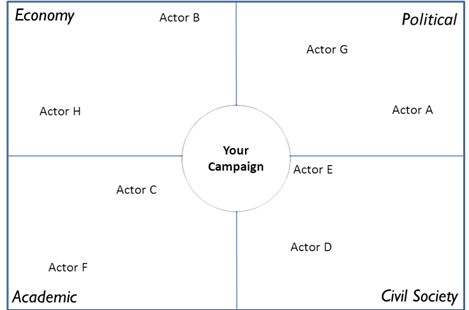
The closer to you the actors are located on the chart, the more intensive is the contact (in terms of frequency of contact, degree of collaboration, common goals and other factors you may determine). The example above focuses on the sectors “economy”, “political”, “academic” and “civil society”. In the example, political and economic actors are not very close to the campaign. In the academic field and civil society, the campaign has close contacts to two actors (actor E and actor C). Depending on the campaign strategy, it may be necessary in this case to seek additional or closer contacts with economic and political actors.
You can adapt the example and choose different sectors (e.g. to differentiate between types of civil society actors, such as women’s organizations, human rights organizations, other NGOs, faith-based groups), or expand their number and draw a polygonal or circular (“onion”) chart (see Rainbow and onion diagrams).