
- Services for survivors of violence should be funded by the government and provided at no cost to the survivor. National and local governments should fund civil society organisations working on addressing VAW/G and VAC. (Schechtman, 2008)
- Government funding should not be ad hoc; it should be sufficient, predictable and long-term. It should provide support and services to victims and survivors for both short and long term consequences.
- Successful allocations in the sectoral or national budget are linked to the political commitment to the problem. (ICRW, 2003)
- Tracking how government and non-governmental actors allocate and spend resources (“resource flows”) through to the final expenditure, can help assess the impact of funding of VAW/G. Resource flows can also: determine how much of the originally allocated resources reach each level, detect problems, and identify places where funds are not reaching beneficiaries or are being used for purposes other than what was intended. (U4 Anti-Corruption Resource Centre, N.d.; Dehn, Reinikka and Svensson, 2003; Schechtman, 2008.)
- Some financing mechanisms can assist with raising revenue to meet the costs of health care services, such as: tax revenue, social health insurance, user fees, private (for-profit) health insurance, and community funds (UNFPA and UNIFEM, 2006).
- Some innovative methods have been developed in order to improve financing for services to survivors. In the United States, two states have established funding through fines paid by convicted sex offenders (Jewkes, 2006).
- Gender Responsive Budgeting (GRB) initiatives promoted by UNIFEM and other United Nations partners can provide information needed to create enabling policy frameworks, build capacity and strengthen monitoring mechanisms to support accountability to women. GRB is “government planning, programming and budgeting that contributes to the advancement of gender equality and the fulfillment of women's rights. It entails identifying and reflecting needed interventions to address gender gaps in sector and local government policies, plans and budgets. GRB also aims to analyze the gender-differentiated impact of revenue-raising policies and the allocation of domestic resources and Official Development Assistance.” The UN Women sponsored portal on Gender Budgeting provides governments, non-governmental organizations, parliaments and academics with resources for understanding and applying GRB.
Example: In both functional and program classifications, one sometimes finds that the categories are not disaggregated in a way that allows identification of the amounts allocated for the thing you are interested in. In particular, the topic of interest is sometimes grouped with other services. Paraguay’s Senate Commission on Equality, Gender and Social Development encountered this problem when they attempted to find out how much was allocated for sexual and reproductive health by the Ministry of Public Health and Social Welfare. By raising the problem, they succeeded in persuading the Ministry to introduce a separate line item for allocations for purchasing contraceptives. The Commission found that donors were covering 100% of the amount spent on contraceptives. The Municipality of Asuncion was inspired by what was being achieved at national level and asked for UNFPA assistance in doing GRB [Gender Responsive Budgeting] work at municipal level. This initiative resulted in the dropping of user fees for pre- and post-natal care at municipal polyclinics for pregnant adolescents less than 20 years of age. The municipality also increased by 300% the amount allocated for the costs of family planning methods.
- Measuring the economic costs of VAW/G can provide an evidence-base to assist with annual budgeting at the national and sub-national levels:
i) Exact financial figures can help decipher between what is needed and what is available;
ii) Committed and dedicated decision-makers can strengthen their arguments with hard facts about the economic consequences of VAW/G and demonstrate what could be achieved with more money;
iii) Assessing the costs and resources can help set priorities. (Potts, 1999)
- The first known efforts to estimate the economic costs VAW/G started in the late 80s with studies estimating the cost of domestic violence against women. Since then, studies and methodologies have become more sophisticated and ambitious and have been done in many countries (Gancheva and Davidson, 2006). Yet costing estimates vary substantially since they depend on “the data and methodology used, the inclusion or exclusion of different categories, and the monetary value allocated to human life and suffering.” See the World Bank website for additional information.
- Four of the most common methods used for costing are:
- Accounting methodology: consists of calculating the costs of specific categories or costs (see table below). The total cost of VAW/G to society would then be the sum of all categories of costs (Bott, Morrison and Ellsberg, 2005a). Typical of this approach is the calculation and distinguishing of direct and indirect costs (see diagram below).
- Modeling technique: with this method, costs and outcomes from different sources are brought together. Typically this means that the lifetime of a particular patient or of an entire population is replicated, including the “health states they will move into and out of over time because of the intervention or its absence.” (Kuntz and Weinstein 2001, cited in Norman, Spencer and Feder, n.d.)
- Cost-effectiveness analysis: studies that look at measuring the cost of implementing preventive interventions versus the cost of dealing with the outcomes of violence.
- Approximations: this method consists of using the findings of costing studies conducted in other provinces or countries.
|
Cost category |
Description |
Type of cost |
Components |
|
Direct costs |
Direct costs arise directly from acts of violence and require actual payments by individuals or institutions.
|
Medical
|
Hospital inpatient
Hospital outpatient
Transport/ambulance
Physician
Drugs/laboratory tests
Counselling |
|
Non medical |
Policing and imprisonment
Legal services
Foster care
Private security |
||
|
Indirect costs |
Indirect costs are harder to quantify and typically do not factor into budgets. They refer to lost resources and opportunities resulting from violence. |
Tangible
|
Lost productivity (earnings and time)
Lost investments in social capital
Life insurance
Indirect protection
Macroeconomic |
|
Intangible |
Health-related quality of life (pain and suffering, psychological)
Other quality of life (reduced job opportunities, access to schools and public services, participation in community life) |
Source: excerpted/adapted from: WHO and CDC. 2008. Manual for estimating the economic costs of injuries due to interpersonal and self-directed violence, Table 1, pg. 62 and ICRW, 2003, “How to make the law work? Budgetary Implication of Domestic Violence Policies in Latin America”, pg.12. Available in English.
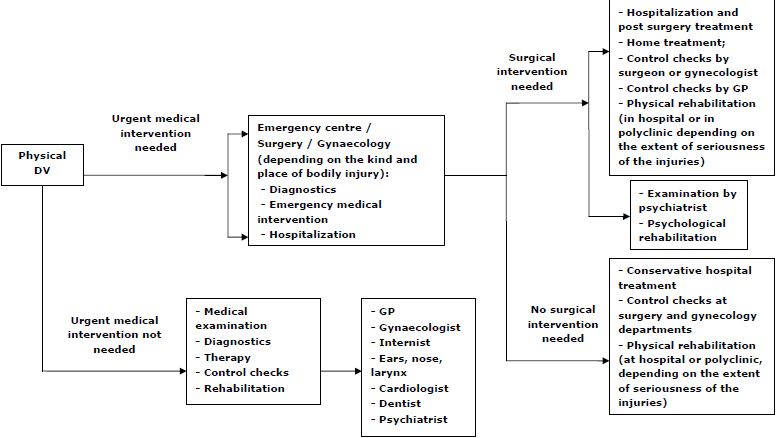
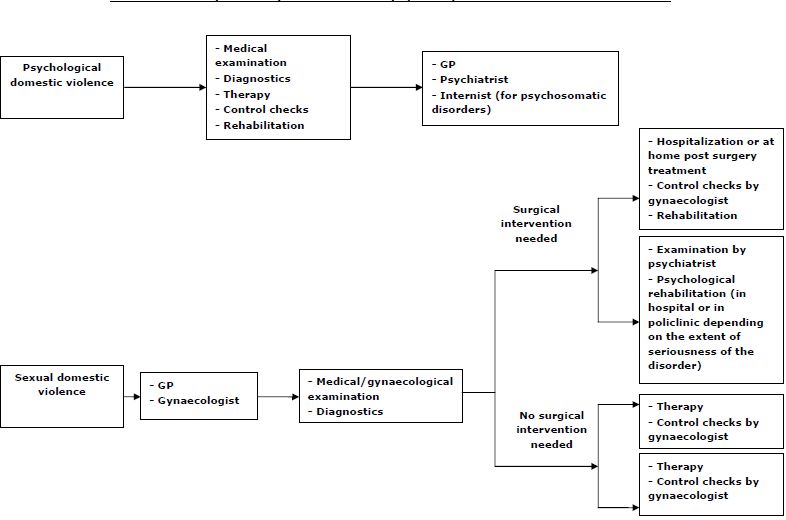
In Macedonia, the institutional health care response to violence against women was mapped to determine what costs need to be accounted for (Gancheva, Y. and Davidson, D.I. (Eds.), 2006. The costs of domestic violence against women in FYR Macedonia. A costing exercise for 2006).
Physical Abuse
Psychological and Sexual Violence
Example: In her 1998 paper The Economic Costs of Violence against Women, economist Ermi Amor Figueroa Yap attempted to identify and quantify, in the Republic of the Philippines’s first exploratory study, the economic cost of VAW. Yap used seven variables, classified into three main groups: costs to the government, the individual victim, and the community. These are: (1) the budget/expenditures of the government on activities related to the treatment; (2) prevention and monitoring of VAW cases; (3) direct expenditures of the individual victim/survivor for medical services, transportation and subsistence allowances; (4) expenditures of the individual for pursuing legal action against the aggressor such s docket and lawyers’ fees; (5) opportunity cost to the individual (income loss) due to absence from work; (6) productivity loss to the market due to absence from work and; (7) opportunity cost to the community such as loss of productivity, reduction of income, higher monitoring costs; and social costs such as breakdown of family and communal relationships, and social unrest.
Yap estimated that the economic cost of domestic violence to the Philippine government reached US$1.7 million per year. According to Yap this estimate does not include expenses incurred in the performance of functions directly related to VAW. The health department, for instance, does not keep track of the medical expenses incurred by the public health system in treating cases of VAW.
Source: excerpted from Mission, Gina. n.d. “The Economic Cost of Violence against Filipino Women.” Provides a summary of the research conducted by economist Ermi Amor Figueroa Yap. Available in English.
Illustrative Resources:
How to make the law work? Budgetary Implication of Domestic Violence Policies in Latin America (International Center for Research on Women, 2003). Available in English.
Health Systems Assessment Approach: A How-to Manual (Islam, M. 2007). See Chapter 7: Health Financing Module. Available in English.
Manual for estimating the economic costs of injuries due to interpersonal and self-directed violence (World Health Organization and Centres for Disease Control and Prevention, 2008). Available in English.
Financial resources management for the Health Sector (U4 Anti-Corruption Resource Centre). Available in English.
Survey Tools for Assessing Performance in Service Delivery (Dehn, J., Reinikka, R. and Svensson, J., 2003). Available in English.
Gender Responsive Budgeting and Women’s Reproductive Rights. A Resource Pack (UNFPA and UNIFEM, 2006). Available in English, French and Spanish.
Paying for Reproductive Health Care: What Is Needed, and What Is Available? (Potts, M., Walsh, J., McAninch, J., Mizoguchi, N. and Wade, T.J. 1999). Family Planning Perspectives (25) Supplement: S10-S16. Available in English.
Cost-Effective Analysis: What You Always Wanted to Know But Were Afraid to Ask (Norman, R., Spencer, A. and Feder, G.) Family Violence Prevention & Health Practice. Available in English.